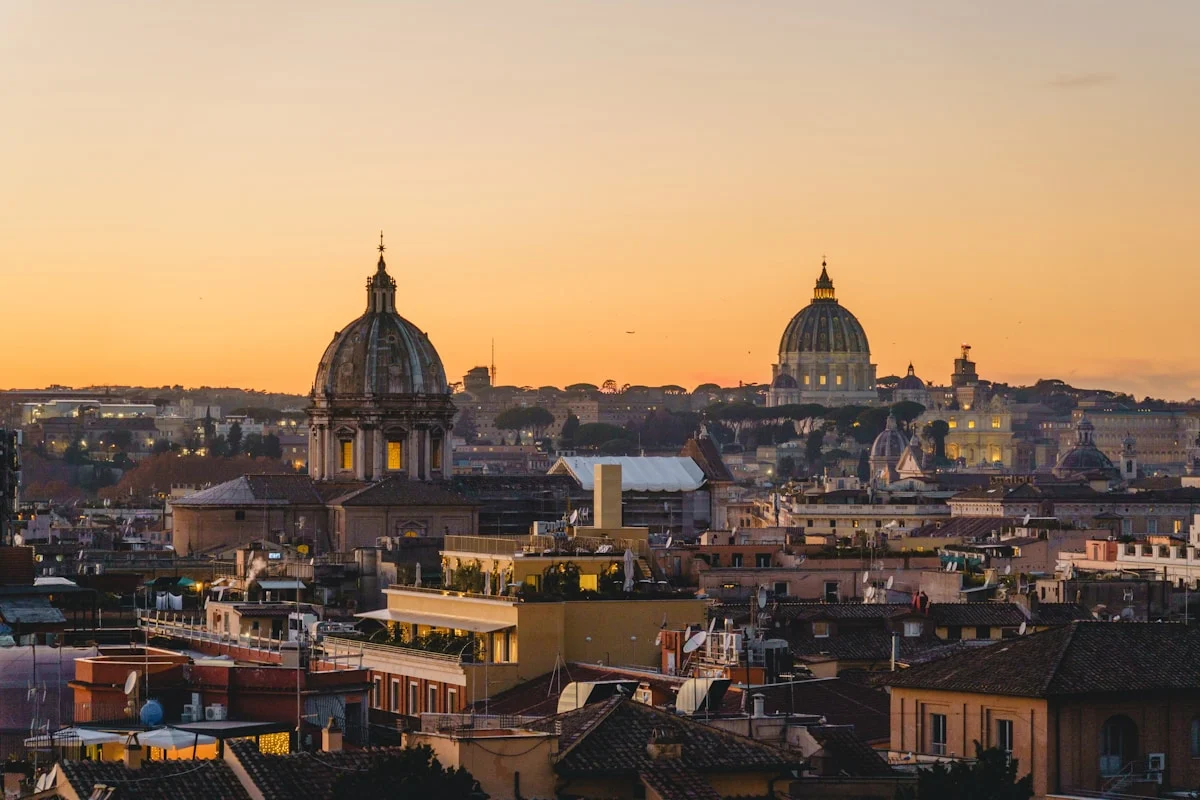
For a street walk beside the Vatican, start outside Castel Sant’Angelo, find the Passetto along Borgo Sant’Angelo and continue into Borgo Pio. From there, head toward Via di Porta Angelica and Piazza del Risorgimento, then follow Via Cola di Rienzo east. Turn toward Piazza Cavour using Via Cicerone and finish with the exterior of the Palazzo di Giustizia. The contrast between Borgo’s narrower streets and Prati’s broader planned blocks gives the route its purpose.
Allow roughly two to two and a half hours with observation stops and one short break. This is my estimate for the outdoor sequence, excluding the castle museum, the basilica and Vatican Museums. It can be shortened at Piazza del Risorgimento if the group has had enough. No shop or restaurant has to be open for the historical comparison to work.
Start outside the castle and look for the Passetto
Begin at the public forecourt outside the castle, then locate Borgo Sant’Angelo and the elevated Passetto. Check the public connecting streets on your map; do not make a full circuit of the museum grounds an obligatory first stage. The castle belongs to Borgo, even though its image also appears in the symbolism of neighboring Prati.
The Passetto connects the Vatican palaces with the castle and served as a protected papal passage. Here you observe its exterior and its relationship to the streets below. Walking along the elevated structure requires its own visitor arrangements; neither an outdoor walk nor an ordinary assumption about castle admission provides access. Choose a place where you can look up without standing in a doorway or vehicle passage.
Enter the scale of Borgo Pio
Make your way into Borgo Pio and walk toward the Via di Porta Angelica side. Notice the short views, relatively narrow fronts and the mixture of food businesses, religious shops and homes. The city’s account describes Borgo as an approach shaped by its proximity to Saint Peter’s and by visitors and pilgrims. Many street names use “Borgo” rather than “Via,” a small clue to the district’s identity.
Compare a residential entrance with a shop opening. Neither souvenir displays nor restaurant tables make the surrounding courtyards public. This street gives a different spatial experience from the broad Via della Conciliazione nearby. The latter followed the demolition of the Spina di Borgo in 1935–37; its open axis should not be imagined as the unchanged historic approach to the basilica.
Use Risorgimento as the turning point
Take Via di Porta Angelica toward Piazza del Risorgimento. This is a useful place to decide whether to continue into Prati or finish the neighborhood walk. Check the actual pedestrian crossings rather than following other people across traffic. Crowds heading toward different Vatican entrances do not necessarily share your destination.
A Vatican Museums appointment needs its own entrance and timing. Reaching this area does not mean reaching the basilica’s security line, either. If an indoor Vatican visit is your priority, use the first-visit planning guide and set a separate approach. The neighborhood route makes no claim to include museum admission or an access shortcut.
Follow Cola di Rienzo into Prati
Continue east along Via Cola di Rienzo. Watch the change in street width, longer views, larger residential blocks and commercial ground floors. Prati developed intensively after Italian unification and Rome’s designation as capital; it became a formal rione in 1921. Its name preserves the memory of meadows near the castle, despite the dense city around you today.
The municipal description highlights substantial Umbertine architecture and more delicate Liberty decoration. Compare repeated window rows and the weight of an entrance, then look for lighter ornamental details where visible. Not every building belongs to one style or one architect. The useful exercise is to identify differences between adjacent façades and between this planned street and Borgo Pio.
Finish at Piazza Cavour
Use Via Cicerone to reach Piazza Cavour. The broader square offers a final comparison with Borgo’s compressed spaces. Look at the Palazzo di Giustizia from outside and distinguish its public monumentality from the residential and commercial fronts you have just passed.
The palace houses the Supreme Court of Cassation and remains a working institution. A prominent door or an attractive staircase is not an invitation to tour the interior. Its large, richly articulated mass is the point of this exterior stop. Choose your onward street or bridge on the map; crossing back into the historic center is an optional continuation with its own distance.
Keep the practical boundaries clear
The core route avoids a Janiculum climb and a descent to the lower Tiber embankment. It still includes kerbs, uneven surfaces, traffic crossings, narrow sections in Borgo and busier junctions in Prati. For limited mobility or a stroller, inspect current crossings, allow pauses and shorten the route when necessary. Broad streets alone do not establish continuous accessible passage.
Ordinary public street walking requires no attraction ticket. Castle, Passetto, Vatican collections and additional paid basilica services have separate arrangements; religious or public events can also redirect movement. For the church itself, consult Saint Peter’s planning. Save the named street sequence with the offline preparation guide and choose whether your day ends at Cavour or continues across the river.
Official sources
ROME WALKS
The city, in your pocket.
A route for your mood. Stories behind the stones. A map that brings it all together.
Get Rome WalksApp Store ↗